Showing posts with label consumers. Show all posts
Showing posts with label consumers. Show all posts
Wednesday, May 14, 2008
Conclusion: Wrap Up of Channel One
Channel One's presence in schools is not appropriate in the classroom environment due to its commercialism. Shown in almost half of the U.S. middle schools and high schools, Channel One is not the daily news show its owners claim. Rather, Channel One is simply a promotional vehicle for its sponsors' products. It is true that schools have the option to enter into a contract with Channel One. However, with the recent explosion of technology and its educational benefits, it is perfectly understandable that less fortunate schools enters into these contracts to receive an upgrade in technology. According to Channel One's advertising policy, the ads presented through this program will be "truthful and tasteful". Through studies and analysis of this program, it is clear that Channel One has not lived up to its policy. Although portrayed as a news program, Channel One seems to be heavy on the fluff/ads and light on the news. Although there is potential for teachers to engage students in classroom discussions of current events shown on Channel One, this rarely occurs as the program airs during non-instructional class periods. To many, Channel One has not added value to students academics and has mostly brought up issues concerning wasted class time and taxpayers' dollars, its emphasis on materialistic values, promotion of unhealthy messages, etc among parents, educators, and policymakers. Originally started in New York, it has recently been banned from all New York public schools and other states such as Oregon and California soon followed. Taking all of this into consideration, what does this tell us about Channel One's educational benefits? Although some may argue a number of points to support this program ,it is clear that it is not appropriate for classroom learning.

Argument 2: Channel One content and a dichotomy between interests
According to a study published in Pediatrics (Weintraub-Austin, et al., 2006), teenagers are more likely to remember the content of advertisements displayed on Channel One News than that of the programming. This news is especially unsettling when one realizes that advertisements comprise less than 20% of the 12-minute program. As a consequence of studies like this one and many others, parents, teachers and various special interest groups are wary of Channel One's implementation of an advertising-based model. Furthermore, many of these groups have called for such companies as Procter & Gamble to pull their ads out of Channel One's lineup, and some states such as New York have even gone as far as banning the use of Channel One in NYS public schools altogether. This type of conflict exemplifies the dichotomy between advertisers and the private rights of individuals. Where should the line be drawn when it comes to when and where an advertiser can communicate a sponsored message? In the case of educational institutions, sponsorships can be found on athletic clothing, scoreboards, school newspapers, and even special projects such as the Pizza Hut Book-It! club. Therefore, many advertisers would argue that advertising-based Channel One is no worse a medium for ads than any other that are in the school system. However, many argue that the Channel One advertising approach is a blatant attempt to prime children for additional consumptive practices later on in life. Additionally, many claim that the existing ads are hedonistic in scope and sensationalistic in nature (Johnston, 2001).
However, it is clear that an advertising-based economy is a pervasive force in America and it will not simply be undone by the protestations of angry consumers. Therefore, it is imperative that advertising companies find less-invasive ways to convey their messages. If they do not, their businesses may take a hit because of the controversy and ensuing pull-out by advertisers. Additionally, if private individuals want to see change in the way advertisers can access such private institutions as the school, then individuals must work to educate the teachers and the institutions themselves.
~ Patrick Castrenze
Please look in the comments section for more information
However, it is clear that an advertising-based economy is a pervasive force in America and it will not simply be undone by the protestations of angry consumers. Therefore, it is imperative that advertising companies find less-invasive ways to convey their messages. If they do not, their businesses may take a hit because of the controversy and ensuing pull-out by advertisers. Additionally, if private individuals want to see change in the way advertisers can access such private institutions as the school, then individuals must work to educate the teachers and the institutions themselves.
~ Patrick Castrenze
Please look in the comments section for more information
Argument 1: "funny" business behind advertising
What does it mean and how does a business effect an educational program when they are prominently an advertising business? Just to give some interesting facts and background on the business behind Channel One.
From the structure of and make-up of the business behind Channel One, a clear distinction of conflict can be seen. Obviously a business will want to promote their products to increase revenue. It seems that Primedia is using Channel One as just another marketing and advertising tool to promote their products through advertisements on Channel One. It would not make sense for Channel One to promote other products that they do not own or represent, so their advertisement segments definitely take advantage of THEIR products and only theirs.
This brings us back to the idea of Channel One advertising being a very biased marketing tool that is creating a monopoly specifically when it comes to the rights to advertising. Similar issues to this arises when companies such as Coca-Cola sign contracts with schools to serve only products produced by Coca-Cola on school property. The question arises, when does this cross the line? Is it fair to only have Coca-Cola products? Is it fair to only have advertisements on Channel One by products OWNED by Channel One? Does the fact that because it is the advertising portion justify the fact that it is biased....as long as it is not the news portion?
An even more general question comes into play. Is it OKAY for an advertising company to own an educational program like Channel One? Or are there too many hidden agendas that goes with this agreement? I guess it is up to the citizens of America to decide, but I believe it is just not right.
~ Grace Oh
Look for more information in the comments section of this post.
- KKR is best known for its leveraged buyout of RJR-Nabisco. R.J. Reynolds (the RJR portion of the company) is the parent of Camel Cigarettes, whose skillful advertising made its "Joe Camel" mascot universally known and widely popular among school-age children.
- Channel One is an advertising vehicle owned by Primedia (formerly K-III Communications), a property of Kohlberg, Kravis & Roberts (KKR), which is well known for corporate takeovers. Channel One broadcasts into 40 percent of U.S. middle and high schools.
- Prior to acquiring Channel One, neither Primedia nor KKR were in the daily news-gathering business. Yet Channel One promotes itself as the primary news delivery system for school-age Americans.
From the structure of and make-up of the business behind Channel One, a clear distinction of conflict can be seen. Obviously a business will want to promote their products to increase revenue. It seems that Primedia is using Channel One as just another marketing and advertising tool to promote their products through advertisements on Channel One. It would not make sense for Channel One to promote other products that they do not own or represent, so their advertisement segments definitely take advantage of THEIR products and only theirs.
This brings us back to the idea of Channel One advertising being a very biased marketing tool that is creating a monopoly specifically when it comes to the rights to advertising. Similar issues to this arises when companies such as Coca-Cola sign contracts with schools to serve only products produced by Coca-Cola on school property. The question arises, when does this cross the line? Is it fair to only have Coca-Cola products? Is it fair to only have advertisements on Channel One by products OWNED by Channel One? Does the fact that because it is the advertising portion justify the fact that it is biased....as long as it is not the news portion?
An even more general question comes into play. Is it OKAY for an advertising company to own an educational program like Channel One? Or are there too many hidden agendas that goes with this agreement? I guess it is up to the citizens of America to decide, but I believe it is just not right.
~ Grace Oh
Look for more information in the comments section of this post.
Sunday, April 27, 2008
Consumer Teens & Teaching Tools
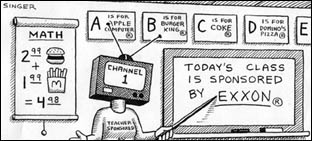
In my last review, I brought up resources that described how the education in the schools of the U.S. is either becoming more unified or divided because of Channel One.
One way that Channel One may be unifying the school education is through how kids are
educated as consumers.
As Darby Saxby in the Yale Journal of Ethics put it: “Today’s schools must develop thinkers, not mere consumers, or they’ll help to produce a society in which everything is for sale - and nothing is worth buying.”
http://www.yale.edu/yje/ch1.html
On Channel One's website, they describe themselves what Channel One is:
What is Channel One?
Viewed by more than 6 million teens a day, Channel One News is a Peabody Award-winning newscast shown in more than 11,000 high schools and junior highs. It is the most highly rated teen show in the country, covering news and public affairs that matter most to young people in America.
Does this create a unified educated public amongst the adolescent age group?
If we recall Bachen's article on "Channel One and the Education of American Youths," she mentions that the program has potential to advance students' knowledge of current events and increase their interest in news, it is highly conditioned on the teachers to create supplementary activities to encourage those interests. Channel One has responded...
Teaching Tools presented on Channel One's website:
These tools are resources for teachers to use to supplement their learning materials and to reinforce in their students what is seen on Channel One. Whether its providing the daily news
script or weekly quizzes, teachers have these pre-packaged convenient short lesson plans on
hand to give to students. But what sort of material does Channel One encourage students retain?
Try this quiz:
CHANNEL ONE NEWS WEEKLY QUIZ
WEEK OF 4/14/08
- Where does the Dalai Lama live? A. Tibet B. India C. Pakistan D. New York
- True or False The “stolen generation” took place from 1869 – 1969 and was a group of British convicts that were forced to live in Australia.
- True or False Last year, scientists discovered a frog with no lungs that can breathe entirely through its skin?
- Which animal is not considered native to Australia? A. Koala B. Emu C. Dingo D. Echidna
- According to Amnesty International, what country executed more people than any other country last year? A. China B. United States C. Soviet Union D. India
- True or False The Kilauea Volcano is one of the most active volcanoes in the world and is located on the island of Fiji.
- What is the name of the current Pope? A. St. Peter B. Pius VII C. John Paul II D. Benedict XVI
- True or False The Prime Minister of Australia recently issued an apology to the Aboriginal people for the government’s stolen generation policies.
- Misty Trainer and Kerri Walsh won the gold medal at the 2004 Olympics for what sport? A. Volleyball B. Basketball C. Soccer D. Gymnastics
- True or False According to researchers at the University of Chicago, people actually grow happier as they grow older.
Is this what the teenagers need to remember? Sounds a bit like trivia to me. But do the teachers even have time to make it through these materials? Again, most times, Channel One is found in schools that are low in financial and physical resources. These schools are likely also trying to make sure that their students pass state mandates on math, science, and English proficiency tests. What role does Channel One play in this? Does it make students more interested in learning? Are they more excited about school when there is Channel One?
These are only a few of the many questions to ask and to consider.
Subscribe to:
Posts (Atom)