Showing posts with label teachers. Show all posts
Showing posts with label teachers. Show all posts
Wednesday, May 14, 2008
Conclusion: Wrap Up of Channel One
Channel One's presence in schools is not appropriate in the classroom environment due to its commercialism. Shown in almost half of the U.S. middle schools and high schools, Channel One is not the daily news show its owners claim. Rather, Channel One is simply a promotional vehicle for its sponsors' products. It is true that schools have the option to enter into a contract with Channel One. However, with the recent explosion of technology and its educational benefits, it is perfectly understandable that less fortunate schools enters into these contracts to receive an upgrade in technology. According to Channel One's advertising policy, the ads presented through this program will be "truthful and tasteful". Through studies and analysis of this program, it is clear that Channel One has not lived up to its policy. Although portrayed as a news program, Channel One seems to be heavy on the fluff/ads and light on the news. Although there is potential for teachers to engage students in classroom discussions of current events shown on Channel One, this rarely occurs as the program airs during non-instructional class periods. To many, Channel One has not added value to students academics and has mostly brought up issues concerning wasted class time and taxpayers' dollars, its emphasis on materialistic values, promotion of unhealthy messages, etc among parents, educators, and policymakers. Originally started in New York, it has recently been banned from all New York public schools and other states such as Oregon and California soon followed. Taking all of this into consideration, what does this tell us about Channel One's educational benefits? Although some may argue a number of points to support this program ,it is clear that it is not appropriate for classroom learning.

Argument 4: Organizations For & Against Channel One + State Bans on Channel One
Reaction to [Channel One] was both swift and passionate. "A friend of mine called me and he went, 'Commercials in school televisions? You out of your mind?'" recalls Ed Winter, a former executive producer of Channel One who now heads his own marketing firm. "'You just declared war on education.'" The controversy soon spread nationwide, and both California and New York banned Channel One from their classrooms
~ PBS Frontline.
Main Points:
More In Depth:
Typical arguments in favor of Channel One include the following:
Channel One news programming goals claim to support these 5 educational goals:
a. Enhance cultural literacy
b. Promote cultural thinking
c. Provide common language & shared experience
d. Provide relevance and motivation
e. Strengthen character and build a sense of responsibility
Banning Channel One from Public Schools:
After reviewing the business side, the content, and the effects of Channel One, we must wonder which institution is on the side of the students' best interests. From the analysis of the organizations that are for and against Channel One, it seems like the business commercial interests are overwhelmingly biased by their personal interests and gains. To the point where any content can be manipulated and claimed useful to the student and the advertisements used as educational tools, and not as the influential mechanisms that they are. As for the states and schools that have banned Channel One, they deserve a round of applause for holding to their convictions.
~ Chin-Shan Jeanne Lee
Please look in the comments section for more information.
~ PBS Frontline.
Main Points:
- Institutions and arguments in favor of Channel One are mostly coming from the company itself and lobbyists.
- Institutions and arguments against Channel One are coming from parties composed of legislators, parents, teachers, and civilians.
- Several states have already moved to ban Channel One from entering public schools.
More In Depth:
Typical arguments in favor of Channel One include the following:
Channel One news programming goals claim to support these 5 educational goals:
a. Enhance cultural literacy
b. Promote cultural thinking
c. Provide common language & shared experience
d. Provide relevance and motivation
e. Strengthen character and build a sense of responsibility
- The producers claim that it increases children's public-affairs knowledge
- Channel One is part of the media literacy movement: more and more health advocates and scholars argue that in a media-saturated society, educators must provide young people with the ability to understand visual elements and message subtexts that are communicated to them in media message
- Channel One advocates assert that it provides young people with news information in an enlightening and age-appropriate style, and its Web site promises everything from "issues in the news to what happens in school" (www.channelone.com).
- Some studies have shown that male students, high academic performers, older students, and those who discuss Channel One with teachers and parents are more likely to benefit from the programming.
- Critics argue that Channel One accomplishes little beyond providing a captive audience for teen-targeted advertising, forcing children to watch ads
- Channel One wastes precious time in schools. Schools showing Channel One spend the equivalent of one full week each school year watching Channel One, including nearly one class day watching ads.
- Channel One misuses tax dollars spent on schools.
- Channel One—not parents or school boards—chooses its ads and program content, taking the parents’ say on what affects their children’s lives.
Banning Channel One from Public Schools:
- When Channel One was in its early stages, the owner, Whittle, spent 6 months lobbying to obtain access to New York State’s student market, the second largest in the U.S.
- California has also banned Channel One
- In 2001, Seattle began to phase out Channel One news in middle schools and high schools by the end of 2004-05 school year.
After reviewing the business side, the content, and the effects of Channel One, we must wonder which institution is on the side of the students' best interests. From the analysis of the organizations that are for and against Channel One, it seems like the business commercial interests are overwhelmingly biased by their personal interests and gains. To the point where any content can be manipulated and claimed useful to the student and the advertisements used as educational tools, and not as the influential mechanisms that they are. As for the states and schools that have banned Channel One, they deserve a round of applause for holding to their convictions.
~ Chin-Shan Jeanne Lee
Please look in the comments section for more information.
Sunday, May 11, 2008
Useful Book Resources on the Topic of Channel One
The following books are helpful to look at to get a better idea of what impact Channel One has on society, especially in schools and children. Many of these books can also be found on Google books previews or Amazon. I've included the descriptions that can be found on the book details.

By Ann De Vaney. Published 1994.
Watching Channel One: The Convergence of Students, Technology, and Private Business
Description: The book covers case studies, research studies, as well as personal stories from parents, teachers, and students. The book comes from an approach analyzing commercial interests (advertising), social, political, and ethical implications of Channel One.

By Randall Curren. Published 2006.
Philosophy of Education
Description: An Anthology brings together the essential historical and contemporary readings in the philosophy of education. Addresses topical issues such as teacher professionalism and accountability, the commercialization of schooling, multicultural education, and parental choice.

By Brian Goldfarb. Published 2002.
Visual Pedagogy: Media Cultures in and Beyond the Classroom
Description: Combining media studies, pedagogical theory, and art history, and including an appendix of visual media resources and ideas about the most productive ways to utilize visual technologies for educational purposes, Visual Pedagogy will be useful to educators, administrators, and activists.

By Juliet B. Schor. Published 2004.
Born to Buy
Description: Sophisticated advertising strategies convince kids that products are necessary to their social survival. Ads affect not just what they want to buy, but who they think they are and how they feel about themselves. Based on long-term analysis, Schor reverses the conventional notion of causality: it's not just that problem kids become overly involved in the values of consumerism; it's that kids who are overly involved in the values of consumerism become problem kids. In this revelatory and crucial book, Schor also provides guidelines for parents and teachers.

By Deron Boyles. Published 1998.
American Education and Corporations: The Free Market Goes to School
Description: This work argues that private businesses use public schools as worker training sites, resulting in a devalued teaching force, students as uncritical consumers, and schools as economic markets. Boyles analyzes school-business partnerships, revealing false philanthropy and the ulterior motives behind fast-food reading campaigns and supermarket "sales for schools" promotions.

By Roy F. Fox. Published 1996.
Harvesting Minds: How TV Commercials Control Kids
Description: (Review) In this eye-opening work, Fox explores the impact of the commercials carried by Channel One--and, by extension, all media--on children, how children respond to these commercials, and what we can do about the situation. Publishers Weekly
By Ann De Vaney. Published 1994.
Watching Channel One: The Convergence of Students, Technology, and Private Business
Description: The book covers case studies, research studies, as well as personal stories from parents, teachers, and students. The book comes from an approach analyzing commercial interests (advertising), social, political, and ethical implications of Channel One.
By Randall Curren. Published 2006.
Philosophy of Education
Description: An Anthology brings together the essential historical and contemporary readings in the philosophy of education. Addresses topical issues such as teacher professionalism and accountability, the commercialization of schooling, multicultural education, and parental choice.
By Brian Goldfarb. Published 2002.
Visual Pedagogy: Media Cultures in and Beyond the Classroom
Description: Combining media studies, pedagogical theory, and art history, and including an appendix of visual media resources and ideas about the most productive ways to utilize visual technologies for educational purposes, Visual Pedagogy will be useful to educators, administrators, and activists.
By Juliet B. Schor. Published 2004.
Born to Buy
Description: Sophisticated advertising strategies convince kids that products are necessary to their social survival. Ads affect not just what they want to buy, but who they think they are and how they feel about themselves. Based on long-term analysis, Schor reverses the conventional notion of causality: it's not just that problem kids become overly involved in the values of consumerism; it's that kids who are overly involved in the values of consumerism become problem kids. In this revelatory and crucial book, Schor also provides guidelines for parents and teachers.
By Deron Boyles. Published 1998.
American Education and Corporations: The Free Market Goes to School
Description: This work argues that private businesses use public schools as worker training sites, resulting in a devalued teaching force, students as uncritical consumers, and schools as economic markets. Boyles analyzes school-business partnerships, revealing false philanthropy and the ulterior motives behind fast-food reading campaigns and supermarket "sales for schools" promotions.
By Roy F. Fox. Published 1996.
Harvesting Minds: How TV Commercials Control Kids
Description: (Review) In this eye-opening work, Fox explores the impact of the commercials carried by Channel One--and, by extension, all media--on children, how children respond to these commercials, and what we can do about the situation. Publishers Weekly
Wednesday, May 7, 2008
A general picture of Channel One
Taking a snapshot look at the Channel One company from the words of multiple sources in recent news and research:
Google Finance & Hoover:
"This company hopes when students need news, they'll tune in to its TV channel first. Channel One operates the Channel One Network, a satellite channel that reaches about 7 million students in more than 300,000 classrooms with daily newscasts and educational videos. Launched in 1990, Channel One provides schools with the necessary broadcast equipment (TVs, monitors, satellite dishes) to view its programs free of charge. It also offers news and programming on its Web site. Most of the company's revenues come from advertising. Marketing and media company Alloy acquired Channel One from magazine publisher PRIMEDIA in 2007. "
Media Post:
"In addition to interactivity and a crisper picture, digital distribution also benefits advertisers--making it easier to change the geographic coverage, creative content, and frequency of their ad campaigns. Channel One's 12-minute morning newscast, including two minutes of advertising, reaches about 6 million teenagers in 10,000 high schools across the country.
Last year, Channel One also struck a deal with NBC News for branded news content produced specially for Channel One, and tailored to the teenaged classroom audience. Channel One next plans to introduce student feedback and journalism platforms, giving students a chance to participate in news production.
If they haven't already, place-based and out-of-home video networks are hurrying to upgrade to digital distribution, in part because of the flexibility and control it offers advertisers. "
IPTV Technology:
By upgrading to digital technology, the Channel One Network will be able to deliver a sharper viewing experience of its news programming and it will ensure content can be easily integrated into today’s learning environment.
...Channel One News programming has been featured on leading networks and news programs, including NBC's Nightly News and The Today Show, CNN, ABC News, and Nightline.
With this movement to digital infrastructure, Channel One Network schools received a digital receiver head-end that is more flexible and has increased storage capabilities. It also allows programming to be burned directly to DVDs.
The investment in new technology this school year adds to a number of steps taken to make sure Channel One Network continues to provide high-quality programming and content, including upgrades to ChannelOne.com’s 24/7 broadband video news channel, ‘Livewire’, and a relationship with NBC News that allows the network to reach more global viewers.
According to Chief Executive Officer of Channel One Network, Kent Haehl, “We will continue to invest in technologies that allow us to stay on pace with a changing media environment, and provide an engaging, viewing experience to the many who rely on Channel One as their only source of news.”
Paul Folkemer, senior vice president of education at Channel One Network added, “With the new digital format, we will be able to provide a more engaging current events program for our students. Video-based learning improves the ability to understand and recall information. The new digital Channel One format will enhance an already valuable resource for educators who are using our program to ensure that their students know what is happening in the world.” "
http://iptv.tmcnet.com/topics/iptv-technology/articles/26746-channel-one-enhances-viewing-learning-with-digital-technology.htm
Channel One Revisited: Prospective Teachers and the Role of American Higher Education:
A. J. Angulo & Susan K. Green
"Channel One is a privately-owned technology and news broadcast company that reaches...almost one-third of the nation’s middle and high school students between the ages of 12 and 17 (Channel One, 2006). Due to its size and scope, Channel One represents one of the single most successful diffusions of technology in public school history. Schools that enroll in Channel One’s services receive technology (i.e., televisions, VCRs, satellite dishes) and a direct link to the company’s 12-minute daily news and advertising broadcast. These schools receive the equipment in exchange for a contractual agreement stipulating that the televised news and advertisements will be shown to at least 90% of the school’s classrooms every day of the academic year."
Google Finance & Hoover:
"This company hopes when students need news, they'll tune in to its TV channel first. Channel One operates the Channel One Network, a satellite channel that reaches about 7 million students in more than 300,000 classrooms with daily newscasts and educational videos. Launched in 1990, Channel One provides schools with the necessary broadcast equipment (TVs, monitors, satellite dishes) to view its programs free of charge. It also offers news and programming on its Web site. Most of the company's revenues come from advertising. Marketing and media company Alloy acquired Channel One from magazine publisher PRIMEDIA in 2007. "
http://finance.google.com/finance?cid=7634939
Media Post:
"In addition to interactivity and a crisper picture, digital distribution also benefits advertisers--making it easier to change the geographic coverage, creative content, and frequency of their ad campaigns. Channel One's 12-minute morning newscast, including two minutes of advertising, reaches about 6 million teenagers in 10,000 high schools across the country.
Last year, Channel One also struck a deal with NBC News for branded news content produced specially for Channel One, and tailored to the teenaged classroom audience. Channel One next plans to introduce student feedback and journalism platforms, giving students a chance to participate in news production.
If they haven't already, place-based and out-of-home video networks are hurrying to upgrade to digital distribution, in part because of the flexibility and control it offers advertisers. "
http://publications.mediapost.com/index.cfm?fuseaction=Articles.showArticleHomePage&art_aid=81880
IPTV Technology:
By upgrading to digital technology, the Channel One Network will be able to deliver a sharper viewing experience of its news programming and it will ensure content can be easily integrated into today’s learning environment.
...Channel One News programming has been featured on leading networks and news programs, including NBC's Nightly News and The Today Show, CNN, ABC News, and Nightline.
With this movement to digital infrastructure, Channel One Network schools received a digital receiver head-end that is more flexible and has increased storage capabilities. It also allows programming to be burned directly to DVDs.
The investment in new technology this school year adds to a number of steps taken to make sure Channel One Network continues to provide high-quality programming and content, including upgrades to ChannelOne.com’s 24/7 broadband video news channel, ‘Livewire’, and a relationship with NBC News that allows the network to reach more global viewers.
According to Chief Executive Officer of Channel One Network, Kent Haehl, “We will continue to invest in technologies that allow us to stay on pace with a changing media environment, and provide an engaging, viewing experience to the many who rely on Channel One as their only source of news.”
Paul Folkemer, senior vice president of education at Channel One Network added, “With the new digital format, we will be able to provide a more engaging current events program for our students. Video-based learning improves the ability to understand and recall information. The new digital Channel One format will enhance an already valuable resource for educators who are using our program to ensure that their students know what is happening in the world.” "
http://iptv.tmcnet.com/topics/iptv-technology/articles/26746-channel-one-enhances-viewing-learning-with-digital-technology.htm
A. J. Angulo & Susan K. Green
"Channel One is a privately-owned technology and news broadcast company that reaches...almost one-third of the nation’s middle and high school students between the ages of 12 and 17 (Channel One, 2006). Due to its size and scope, Channel One represents one of the single most successful diffusions of technology in public school history. Schools that enroll in Channel One’s services receive technology (i.e., televisions, VCRs, satellite dishes) and a direct link to the company’s 12-minute daily news and advertising broadcast. These schools receive the equipment in exchange for a contractual agreement stipulating that the televised news and advertisements will be shown to at least 90% of the school’s classrooms every day of the academic year."
http://www.springerlink.com/content/w33723h0117u6522/fulltext.pdf
Sunday, April 27, 2008
Consumer Teens & Teaching Tools
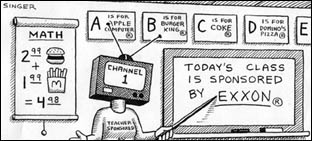
In my last review, I brought up resources that described how the education in the schools of the U.S. is either becoming more unified or divided because of Channel One.
One way that Channel One may be unifying the school education is through how kids are
educated as consumers.
As Darby Saxby in the Yale Journal of Ethics put it: “Today’s schools must develop thinkers, not mere consumers, or they’ll help to produce a society in which everything is for sale - and nothing is worth buying.”
http://www.yale.edu/yje/ch1.html
On Channel One's website, they describe themselves what Channel One is:
What is Channel One?
Viewed by more than 6 million teens a day, Channel One News is a Peabody Award-winning newscast shown in more than 11,000 high schools and junior highs. It is the most highly rated teen show in the country, covering news and public affairs that matter most to young people in America.
Does this create a unified educated public amongst the adolescent age group?
If we recall Bachen's article on "Channel One and the Education of American Youths," she mentions that the program has potential to advance students' knowledge of current events and increase their interest in news, it is highly conditioned on the teachers to create supplementary activities to encourage those interests. Channel One has responded...
Teaching Tools presented on Channel One's website:
These tools are resources for teachers to use to supplement their learning materials and to reinforce in their students what is seen on Channel One. Whether its providing the daily news
script or weekly quizzes, teachers have these pre-packaged convenient short lesson plans on
hand to give to students. But what sort of material does Channel One encourage students retain?
Try this quiz:
CHANNEL ONE NEWS WEEKLY QUIZ
WEEK OF 4/14/08
- Where does the Dalai Lama live? A. Tibet B. India C. Pakistan D. New York
- True or False The “stolen generation” took place from 1869 – 1969 and was a group of British convicts that were forced to live in Australia.
- True or False Last year, scientists discovered a frog with no lungs that can breathe entirely through its skin?
- Which animal is not considered native to Australia? A. Koala B. Emu C. Dingo D. Echidna
- According to Amnesty International, what country executed more people than any other country last year? A. China B. United States C. Soviet Union D. India
- True or False The Kilauea Volcano is one of the most active volcanoes in the world and is located on the island of Fiji.
- What is the name of the current Pope? A. St. Peter B. Pius VII C. John Paul II D. Benedict XVI
- True or False The Prime Minister of Australia recently issued an apology to the Aboriginal people for the government’s stolen generation policies.
- Misty Trainer and Kerri Walsh won the gold medal at the 2004 Olympics for what sport? A. Volleyball B. Basketball C. Soccer D. Gymnastics
- True or False According to researchers at the University of Chicago, people actually grow happier as they grow older.
Is this what the teenagers need to remember? Sounds a bit like trivia to me. But do the teachers even have time to make it through these materials? Again, most times, Channel One is found in schools that are low in financial and physical resources. These schools are likely also trying to make sure that their students pass state mandates on math, science, and English proficiency tests. What role does Channel One play in this? Does it make students more interested in learning? Are they more excited about school when there is Channel One?
These are only a few of the many questions to ask and to consider.
Subscribe to:
Posts (Atom)